
The Gut-Brain Axis: How Your Gut and Mental Health Are Connected
Sep 25, 2026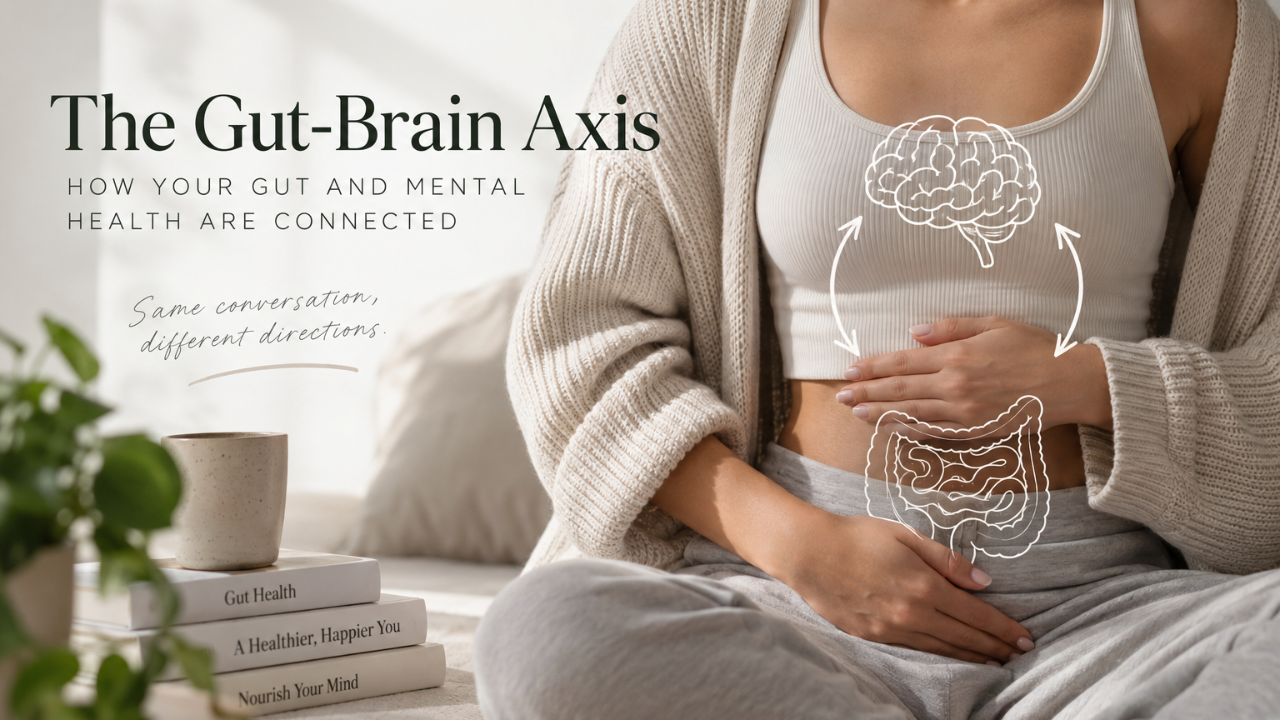
Have you ever felt nauseous before a big test? Lost your appetite when you were anxious? Or had your boss suddenly drop a meeting on you and immediately felt like you needed to run to the toilet?
That isn't just in your head.
Your gut and brain are constantly communicating with each other through something called the gut-brain axis. And importantly, that communication goes both ways.
What actually is the gut-brain axis?
I like to explain the gut-brain axis as a highway.
There are lanes travelling in both directions. We can get from A → B, but we can also get from B → A.
The messages between your gut and brain work in a similar way. Your brain can influence what happens in your digestive system, while your gut is constantly sending information back to your brain.
It's why our thoughts and emotions can create very real physical gut symptoms.
Think about those butterflies before doing something scary, nausea when you're anxious or completely losing your appetite during a stressful period.
That's the gut-brain axis in action.
How are your gut and brain communicating?
One of the major communication pathways between the brain and gut is the vagus nerve. Think of this as one of the big roads on our highway.
But it isn't the only one.
Your nervous system, hormones, immune system and gut microbiome are all involved in this communication network. Together, they're constantly sending information backwards and forwards about what's happening throughout the body.
This is why we can't really look at gut health completely separately from things like stress, mental health, nutrition, sleep and our overall health.
Why does stress affect your gut?
This is probably one of the easiest parts of the gut-brain connection to notice in everyday life.
When we're under stress, our body activates its stress response and releases hormones including cortisol and adrenaline.
Historically, this response was incredibly useful. If there was a tiger chasing you, your body didn't particularly care about comfortably digesting lunch. It needed to prioritise the systems that were going to help keep you alive.
Obviously, most of us aren't running away from tigers anymore.
Instead, we're dealing with work deadlines, finances, family responsibilities, training, appointments and the enormous cognitive load that can come with modern life.
The problem is that our body can still respond to stress as though something needs our immediate attention.
That stress response can influence digestive function and gut motility, which is one reason periods of increased stress can come alongside changes in bowel motions, diarrhoea or constipation, nausea, appetite changes, bloating and abdominal discomfort.
It doesn't mean stress is necessarily the cause of every gut symptom. But it can absolutely be part of the picture.
But doesn't the gut affect the brain too?
“Okay Emma, you've explained how my brain affects my gut. This is starting to sound like it's all the brain's fault.”
Sorry to ruin what would have been a very simple solution, but remember our highway has lanes travelling in both directions.
I tend to think about this more like a cycle.
Think about how you feel when you're experiencing significant gut pain or symptoms. How motivated are you to eat properly? Exercise? Drink enough water? Socialise? Sleep well?
Probably not particularly.
If symptoms then cause you to eat less, restrict more foods or struggle to meet your nutritional requirements, we can create another problem. Your body and brain still need adequate energy and nutrients to function.
Meanwhile, living with ongoing pain and unpredictable gut symptoms can itself be stressful and have a very real impact on someone's quality of life and mental health.
So the cycle continues.
The gut microbiome — without the hype
This is where the gut microbiome comes in.
I like to describe your microbiome as a terrarium.
A healthy terrarium isn't just about putting lots of plants inside it. You need the right soil, enough water, appropriate light and a variety of living things all working together to create an ecosystem.
Your gut microbiome is also an incredibly complex ecosystem.
What we eat is one of many things that can influence it, and eating a varied, nutritionally adequate diet can help support that environment.
If your intake becomes extremely restricted, however, you're potentially giving that ecosystem less variety to work with.
“So should I just take a probiotic and create the perfect microbiome?”
Not quite.
Probiotics can be useful in particular circumstances, but there isn't one universally “perfect” microbiome that we're all trying to create.
And I like to bring it back to our terrarium: adding a probiotic without looking at someone's overall nutrition is a little like putting new plants into a terrarium without considering whether you've created the conditions needed to support them.
Sometimes we need to look at the environment first.
The restriction trap
This is something I see commonly with people experiencing ongoing gut symptoms.
“But Emma, I get symptoms when I eat these foods. Of course I've cut them out.”
And I completely understand why.
When eating something seems to repeatedly leave you bloated, in pain or running to the bathroom, avoiding it feels like the logical thing to do.
The problem is when one food becomes three foods, which becomes a food group, which becomes multiple food groups; and suddenly someone is living on a very small number of foods because they're terrified of triggering symptoms.
That's when I want to know whether we've actually established that those foods are the problem.
Food intolerances absolutely exist, and food can contribute to gastrointestinal symptoms. But symptoms can also change depending on portion size, overall diet, stress, sleep, hydration, eating patterns and an underlying gastrointestinal condition.
That's why simply removing more and more foods isn't always the answer.
Sometimes we need to carefully reintroduce foods and look for patterns under more controlled conditions, ideally when someone is adequately nourished, eating regularly, hydrated and getting reasonable sleep.
And depending on the symptoms and suspected condition, that process may be best done with a dietitian or medical team rather than continuing to experiment alone.
So, what can you actually do?
Before trying to find the perfect probiotic or cutting another food from your diet, I like to come back to the basics.
Are you eating regularly? Are you eating enough overall? Are you getting a reasonable variety of foods? Are you drinking enough? How is your sleep? Are you moving your body? And what is happening with your stress levels?
None of those things are particularly exciting.
But they're often much more useful starting points than immediately adding another supplement or restriction.
It can also help to look for patterns in your symptoms rather than judging individual foods in isolation. What else was happening that day? Had you eaten enough? Were you particularly stressed? Had you slept badly? Is this something that happens every time you eat that food, or only sometimes?
Your symptoms are information. We just need to work out what they're actually telling us.
When gut symptoms need more investigation
I do believe a lot of gut symptoms can improve with practical nutrition and lifestyle strategies and having the right team around you.
But that doesn't mean every gut symptom should be blamed on stress, anxiety or the gut-brain axis.
Conditions including coeliac disease, inflammatory bowel diseases such as Crohn's disease, and other gastrointestinal or autoimmune conditions can affect gut function and require proper medical investigation and treatment.
Persistent, severe or changing gastrointestinal symptoms deserve assessment rather than endlessly changing your diet trying to figure them out yourself.
Sometimes we can start with some really simple things.
And sometimes we need to investigate further.
The important part is recognising that gut health isn't just about your gut. Your nutrition, nervous system, mental health, sleep, lifestyle and medical history can all form part of the picture.
Your gut and brain are constantly talking to each other.
Sometimes the best thing we can do is stop trying to silence the symptoms, and start working out what that conversation is actually saying.
Stay connected with news and updates!
Get expert tips, practical resources, and supportive advice for everything from fussy eating and ARFID to building a healthy relationship with food, managing weight, and fuelling your body with confidence. Subscribe now to get exclusive content delivered straight to your inbox.
We hate SPAM. We will never sell your information, for any reason.